github-to-sqlite 2.9.1
github-to-sqlite 2.9.1
Release: github-to-sqlite 2.9.1 Fix for compatibility with sqlite-utils 4.x. #85 Tags: github, sqlite
Lire
Release: github-to-sqlite 2.9.1 Fix for compatibility with sqlite-utils 4.x. #85 Tags: github, sqlite
Release: datasette 0.65.4 See Datasette 1.0a39 and 0.65.4 security releases on the Datasette blog. Tags: security, datasette
Release: datasette 1.0a39 See Datasette 1.0a39 and 0.65.4 security releases on the Datasette blog. Tags: security, datasette
Any Nix package, live in your browser Farid Zakaria calls this his "magnum opus of Nix work", and I can see why. trynix.dev provides a qemu-wasm powered x86_64 Linux virtual machine running entirely in your browser through WebAssembly. That VM can then be booted with any Nix package from the past 13 years. They are URL addressable, so you can navigate to this page: https://trynix.dev/?pkg=python3%403.6.2 Then click "Load" and get an interactive shell against a virtual machine running Python…
Native is now the future of mobile at Shopify Shopify are moving from React Native back to separate Swift and Kotlin codebases for their native apps, for the exact reason you would expect: We decided to switch from native to React Native in 2020 for three reasons: Stop building the same features twice Allow developers to work across the stack Spend less time chasing feature parity and more time shipping value [...] Native still means building and maintaining software on two platforms, that cost…
Today, we're releasing a demo of WeWorm, the first zero-click worm to spread through WeChat calls across iOS and Android. [...] The victim does not need to answer the call, or interact with their phone at all. Even if they do answer, they hear nothing, and the exploit still succeeds. [...] Working with AI, our team found the bug and wrote the first remote code execution (RCE) exploit in about two days. Building the worm took one more week. A worm at this scale used to be the kind of thing that…
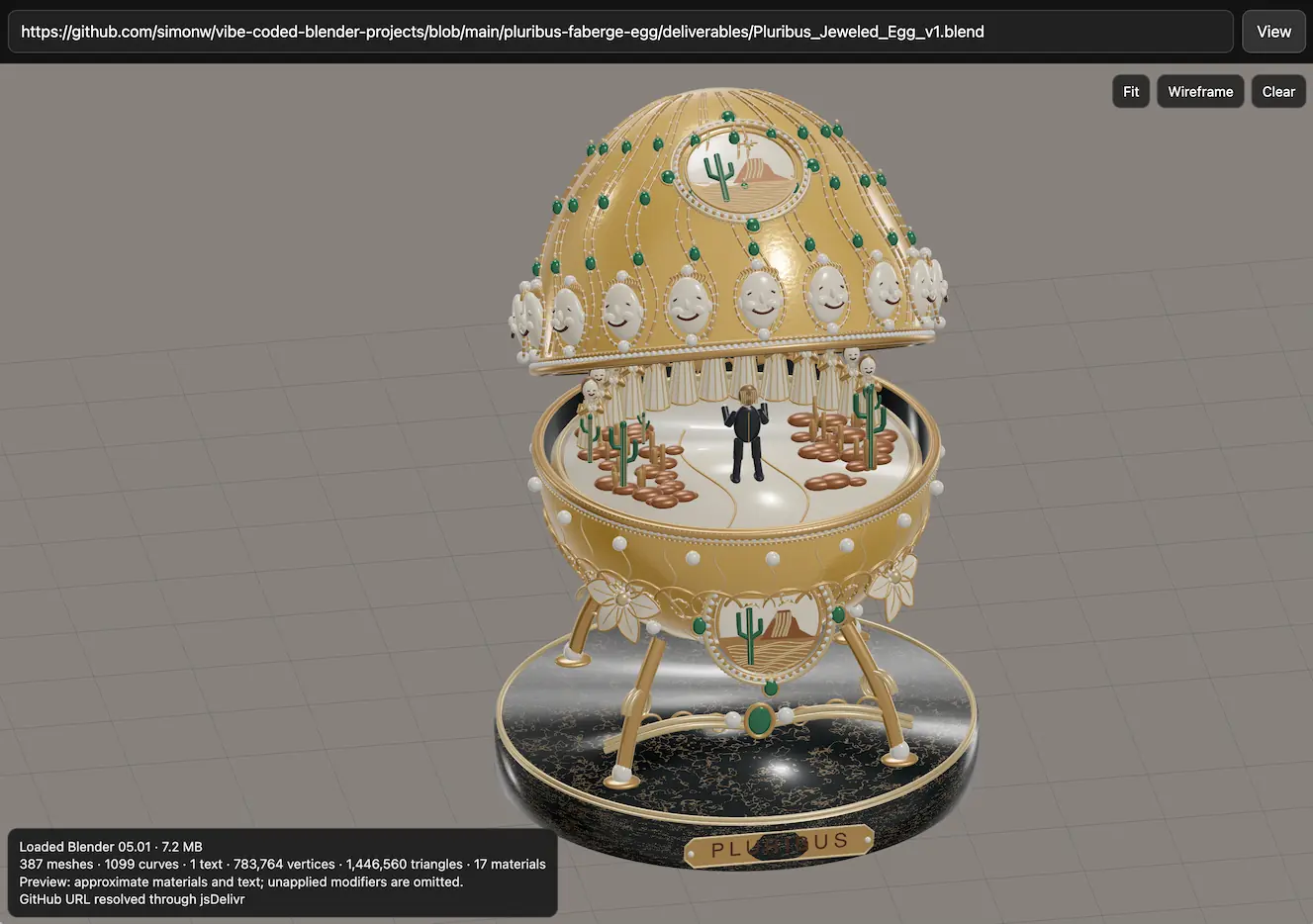
Tool: .blend URL Viewer I'm continuing to have a lot of fun with GPT-6 Astra and Blender (see my TIL). As a big fan of the Imperial Fabergé Easter eggs, I've always thought it would be fun to make some new ones that celebrate popular culture. Yesterday I decided to try out the new ChatGPT Images 2.5 by running this prompt: Generate a photo of a faberge egg that's themed after the TV show Pluribus - research first It gave me this - honestly not bad for a first attempt! Then, just to see what…
I wrote recently about how the collection of good, fruitful open problems is now being mined in a non-renewable fashion, leading to the potential scenario of these problems becoming scarce. [...] We have now seen that even the rumor of someone working on a problem can trigger a massive amount of AI-powered effort to flatten it before the original research project has time to reach its full potential. The incentives may now be pointing in the direction of no longer sharing any promising research…
On the Navier–Stokes Millennium Prize Problem Impressive result from OpenAI, who used an unreleased model to produce a resolution to the Navier–Stokes existence and smoothness problem, one of the seven Millennium Prize Problems that have been subject to a $1,000,000 prize since May 24th, 2000. The discovery is somewhat overshadowed by accusations of skulduggery from Tristan Buckmaster, an NYU mathematics professor who was collaborating on related problems with Levent Alpöge, an accomplished…
Introducing ChatGPT Images 2.5 OpenAI's image generation models are apparently used "more than 3 billion images across ChatGPT Images and the GPT‑Image models in the API". This latest release improves their instruction-following ability across multiple turns, responds faster, and "is better at preserving the subjects in your reference photos". There are two new model IDs in the API: gpt-image-2.5-sunburst and gpt-image-2.5-flare. Based on this I think Sunburst is the stronger option: Choose…
Release: llm 0.35 New OpenAI model: gpt-6-astra for GPT-6 Astra. Tags: openai, llm, gpt-6-astra
Creepy crawlies Konstantin Ryabitsev discusses how bad the "background radiation" of abusive crawlers has become from the perspective of git.kernel.org, the official Git repository for the Linux kernel: TL;DR: we spend more CPU cycles rendering commits for scrapers than we spend on all other kinds of legitimate access, including git clones. At any one time, across 5 geo-distributed nodes, there are 14 CPU cores doing nothing but rendering git commits as html. I worry about this a lot from the…
The strongest argument I see for continuing to train much smarter models quickly is the need to build defensive systems against the dangers posed by other AI. [...] We will need powerful, aligned AI for defense; to secure infrastructure, to protect against rogue agents in real time, and to invent entirely new protective measures. This will be a primary focus of OpenAI’s deployment efforts. At the same time, even with the uncertainty that comes from anticipated broad AI progress and the need to…
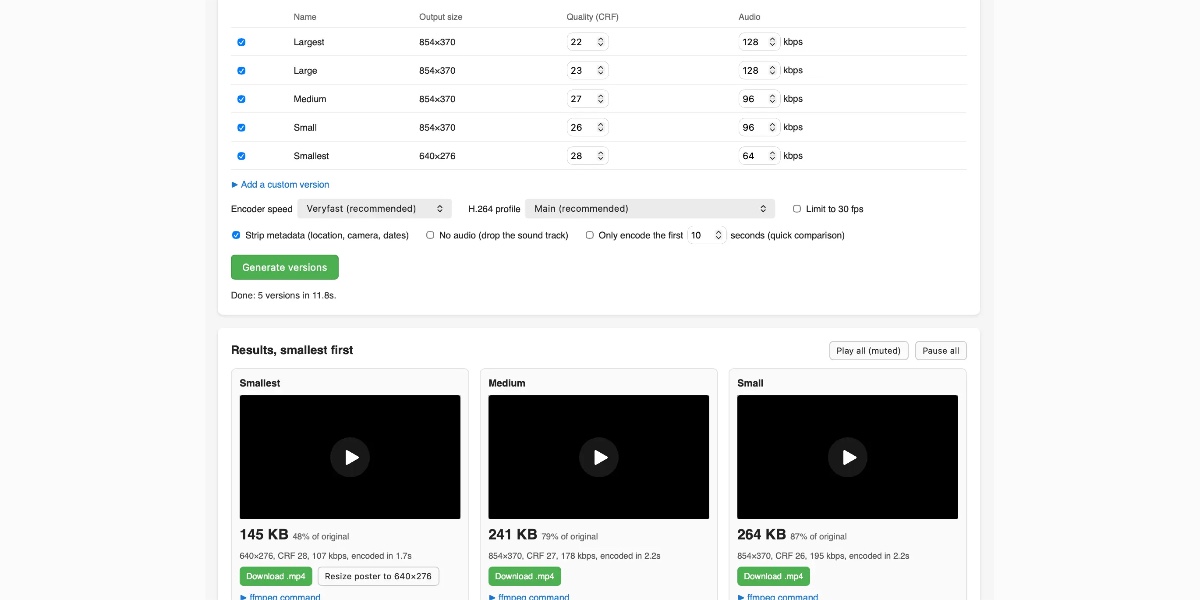
Tool: Video compressor I recorded a short demo video of my Equal Earth animation on my phone and wanted to publish an optimized version of that video (using FFMPEG) on my blog, so I had Claude Fable 5.1 in Claude Code for web build me this tool using the WebAssembly build of FFMPEG. Tags: ffmpeg, video, webassembly, claude, claude-code, claude-mythos-fable
Tool: Mercator ↔ Equal Earth I got curious about the Equal Earth map projection that was recently voted on at the UN so I had GPT-6 Astra (medium) in ChatGPT Work build me this animated transition between Mercator and Equal Earth using D3. Tags: geospatial, d3, vibe-coding, gpt-6-astra