Flux
Couleur d'accent
Toutes les sources

Simon Willison's Weblog

677 articles Flux RSS
IA Programmation
A new feature for my blog, built using my voice

A new feature for my blog, built using my voice

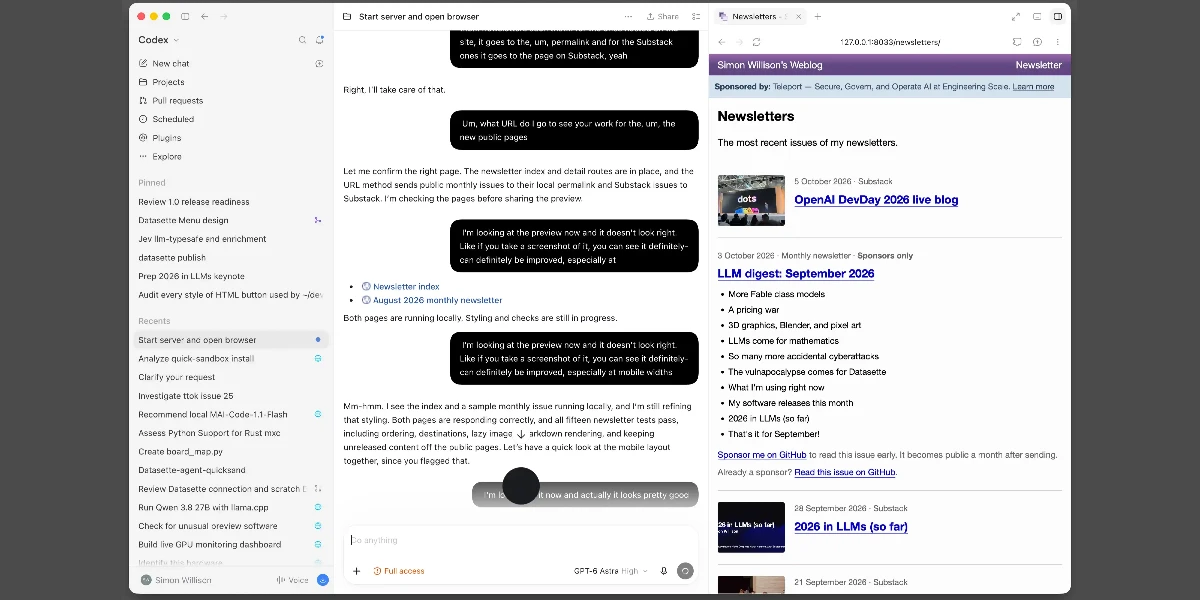
I shipped a new feature for my blog today: the Newsletters page, which offers an index of all of the newsletters I've sent out, both my free weekly Substack and my monthly sponsors-only updates. I built the feature almost entirely using my voice, chatting away to my laptop while I cooked dinner. Codex voice mode I used the ChatGPT desktop app for this, in the Codex tab, using the voice conversation mode, running against a local development environment. Here's what that looks like: I started the…

Simon Willison's Weblog
ttok 1.0

ttok 1.0

Release: ttok 1.0 I released ttok 0.4, ran uv tool upgrade ttok, piped a file into the new version... and realized that it was defaulting to the GPT-4 tokenizer when it should very clearly default to GPT-5/GPT-6 instead! I figured switching the default was a reasonable excuse to finally ship a 1.0. OpenAI haven't actually confirmed that GPT-6 uses the same tokenizer as the GPT-5 family yet - there's an angry issue about it - but I found this commit by William Liu which reports on an experiment…

Simon Willison's Weblog
ttok 0.4

ttok 0.4

Release: ttok 0.4 ttok is my CLI tool for counting tokens, using OpenAI's open source tiktoken library. It hasn't been in updated in a couple of years, but I finally fixed a Click warning, updated CI, and added a --list-models command to list available models. It works with uvx, so you can count tokens in anything like this: cat file.txt | uvx ttok Tags: projects, ai, openai, generative-ai, llms, tokenization

Simon Willison's Weblog
Quoting Carson Gross

Quoting Carson Gross

Computer programming is, fundamentally, about two things: Problem-solving using computers Learning to control complexity while solving these problems I have a hard time imagining a future where knowing how to solve problems with computers and how to control the complexity of those solutions is less valuable than it is today, so I think it will continue to be a viable career even with the advent of AI tools. — Carson Gross Tags: computer-science, carson-gross, careers, ai

Simon Willison's Weblog
Quoting Ben Affleck

Quoting Ben Affleck

I've always been kind of into computers since I was young. And then when film started to move from analog film to digital, I became more interested in that aspect of it. And the visual effects workflow for many years has included machine learning. So I can write like pretty shitty Python scripts and stuff like that because with convolutional neural networks, which were the sort of precursors to what the transformer can do, which is just much more computation simultaneously, you would do things…

Simon Willison's Weblog
Claude Haiku 5.5

Claude Haiku 5.5

As previously promised, here's Anthropic's new fast, low cost model: Introducing Claude Haiku 5.5. The previous Haiku, 4.5, was very much showing its age. It came out almost a year ago, and was priced at $1/million input and $5/million output - relatively expensive even back then, and a full 10x the price of OpenAI's GPT-6 Luna, released last month. The new Haiku exactly matches the price of GPT-6 Luna - $0.10/$0.50 - up to 100,000 tokens. Beyond 100,000 tokens the price increases 5x to…

Simon Willison's Weblog
Anti-Patterns in Software Blogging

Anti-Patterns in Software Blogging

Anti-Patterns in Software Blogging Some excellent writing advice from Michael Lynch. Michael warns against "meandering intros", misjudging your reader's existing knowledge, assuming they'll read your previous posts, and excessive formality. He also warns against overreliance on links as an excuse not to explain terminology. This one hurt! I do this all the time, but I have a nagging suspicion that almost nobody ever clicks on them. (In a Lobste.rs comment Michael clarifies that "My rule of…

Simon Willison's Weblog
Quoting Jake Boggan

Quoting Jake Boggan

I was a graph theory junkie long ago and even moved to Budapest for awhile to study among the greats. While I was there I started working on Barnette's Conjecture which came to occupy my thoughts over the next 24 years of my life, on and off as I worked in many different fields. Last summer I even thought for a few days that I had actually solved it. But it's supposedly proven here - problem 180. I don't know what to think exactly. I spent thousands of hours on that problem. I really enjoyed…

Simon Willison's Weblog
OpenAI “rogue” agent activities found on Wikimedia projects

OpenAI “rogue” agent activities found on Wikimedia projects

OpenAI “rogue” agent activities found on Wikimedia projects Given how tempting a target wikis are for rogue agent swarms, it's not a huge surprise that Wikipedia found evidence of that activity once they went looking: The Wikimedia Foundation conducted its own investigation to see whether Wikimedia websites had been similarly affected by AI agents, focusing on those operated by OpenAI. We can confirm that we have discovered some activity by these “rogue” OpenAI agents on Wikimedia platforms.…

Simon Willison's Weblog
Quoting Victoria Kim

Quoting Victoria Kim

Since the Medicare breach, OpenAI has put in place additional monitoring to allow “immediate intervention” by staff to stop training if the company’s models access the internet in ways they’re not supposed to, Mr. Kwon [chief strategy officer at OpenAI] said. — Victoria Kim, Reporting from the Australian parliament Tags: accidental-cyberattacks, generative-ai, ai-security-research, openai, ai, llms

Simon Willison's Weblog
llm-openai-decisions 0.1a0

llm-openai-decisions 0.1a0

Release: llm-openai-decisions 0.1a0 OpenAI released their new Jev-style Decisions API, as previously announced at last week's DevDay. Since I already have an llm-typesafe plugin for talking to Jev, I had GPT-6 Astra read the new OpenAI API documentation and build an llm-openai-decisions plugin inspired by llm-typesafe. Unlike Jev, the new gpt-6-luna decision model supports image input in addition to text. Both models charge for input it and not for output: OpenAI's is 10 cents per million input…

Simon Willison's Weblog
EmbeddingGemma 2

EmbeddingGemma 2

My comment on EmbeddingGemma 2 — Hacker News.I really appreciate that EmbeddingGemma 2 is under the Apache 2.0 license. For embedding models in particular, I don't think it makes sense to use a closed, proprietary, hosted-only model. Most applications of embedding models involve calculating thousands or even millions of embedding vectors and storing them for later comparison. If your model is proprietary, the vendor is likely someday going to decide to stop offering that model. They'll…

Simon Willison's Weblog
Introducing Mistral Large 4: Le chonk

Introducing Mistral Large 4: Le chonk

Introducing Mistral Large 4: Le chonk Mistral are back in the game. Today they're releasing a preview of Mistral Large 4, a 1 trillion parameter, 49 billion active parameter model trained on their own cluster of 3,800 NVIDIA Grace Blackwell GPUs. The preview is available via their API. They promise to release the open weights model at the "end of this month". The model only supports two reasoning levels - "none" and "high" - via the Mistral API. Here are both pelicans - the "high" one looks…

Simon Willison's Weblog
Using Parseable with Datasette for OpenTelemetry traces

Using Parseable with Datasette for OpenTelemetry traces

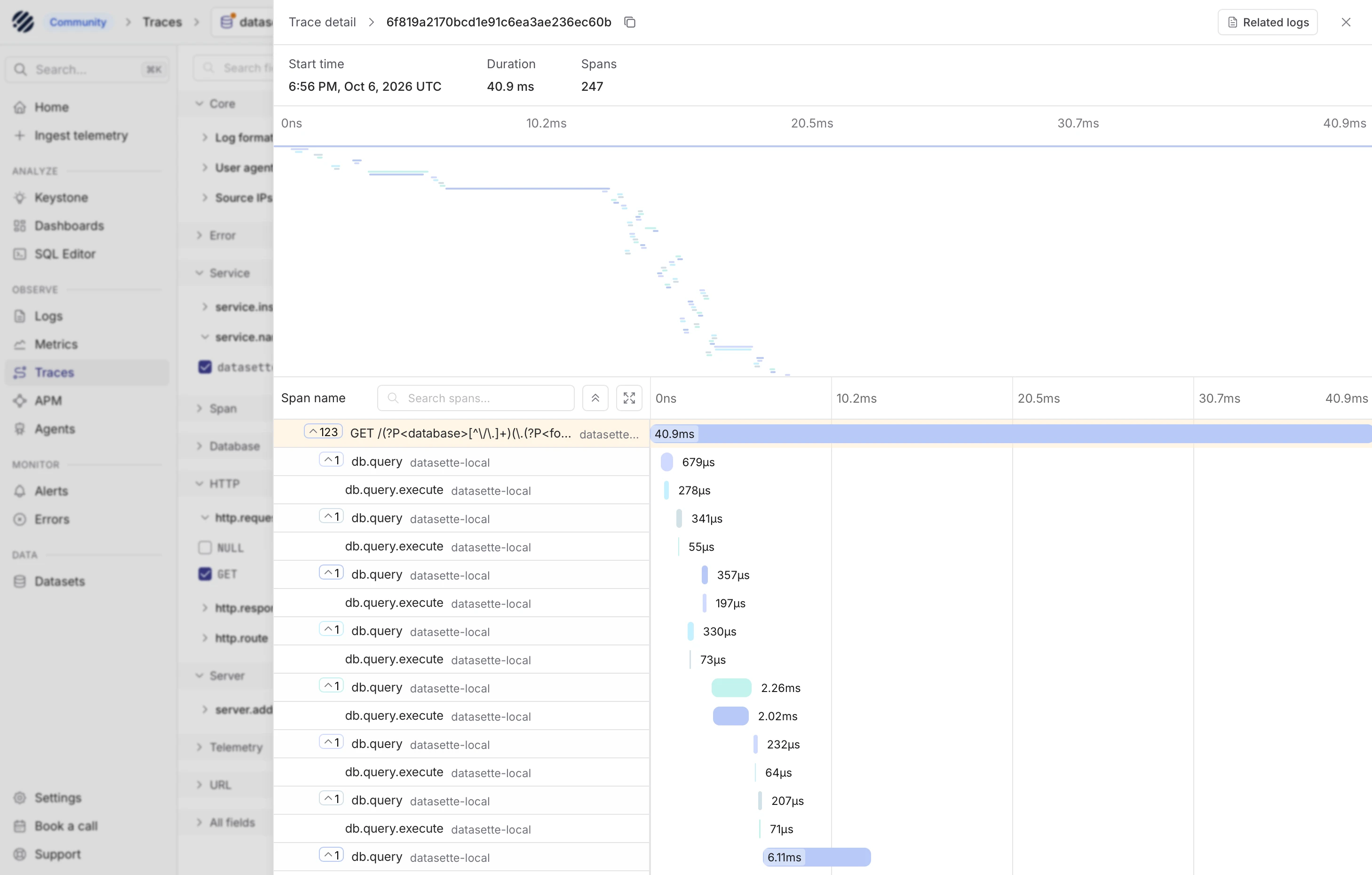
TIL: Using Parseable with Datasette for OpenTelemetry traces I saw Parseable in a Show HN today - it's a new observability platform with both an open source (AGPL) Rust implementation (a single ~180MB binary), an "Enterprise" version with extra features and a cloud hosted option. Since Datasette 1.0a41 added OpenTelemetry support (thanks, Alex Garcia), I decided to fire up Codex and have it figure out how to run Parseable and feed it traces from Datasette. Here's my (human-written) TIL showing…

Simon Willison's Weblog
Esc