Flux
Couleur d'accent
datasette-ports 0.3

datasette-ports 0.3

Release: datasette-ports 0.3 A small update for my tool for helping me figure out what all of the Datasette instances on my laptop are up to. Show working directory derived from each PID Show the full path to each database file Output now looks like this: http://127.0.0.1:8007/ - v1.0a26 Directory: /Users/simon/dev/blog Databases: simonwillisonblog: /Users/simon/dev/blog/simonwillisonblog.db Plugins: datasette-llm datasette-secrets http://127.0.0.1:8001/ - v1.0a26 Directory:…

Simon Willison's Weblog
Zig 0.16.0 release notes: "Juicy Main"

Zig 0.16.0 release notes: "Juicy Main"

Zig 0.16.0 release notes: "Juicy Main" Zig has really good release notes - comprehensive, detailed, and with relevant usage examples for each of the new features. Of particular note in the newly released Zig 0.16.0 is what they are calling "Juicy Main" - a dependency injection feature for your program's main() function where accepting a process.Init parameter grants access to a struct of useful properties: const std = @import("std"); pub fn main(init: std.process.Init) !void { ///…

Simon Willison's Weblog
datasette PR #2689: Replace token-based CSRF with Sec-Fetch-Site header protection

datasette PR #2689: Replace token-based CSRF with Sec-Fetch-Site header protection

datasette PR #2689: Replace token-based CSRF with Sec-Fetch-Site header protection Datasette has long protected against CSRF attacks using CSRF tokens, implemented using my asgi-csrf Python library. These are something of a pain to work with - you need to scatter forms in templates with <input type="hidden" name="csrftoken" value="{{ csrftoken() }}"> lines and then selectively disable CSRF protection for APIs that are intended to be called from outside the browser. I've been following…

Simon Willison's Weblog
Trusted access for the next era of cyber defense

Trusted access for the next era of cyber defense

Trusted access for the next era of cyber defense OpenAI's answer to Claude Mythos appears to be a new model called GPT-5.4-Cyber: In preparation for increasingly more capable models from OpenAI over the next few months, we are fine-tuning our models specifically to enable defensive cybersecurity use cases, starting today with a variant of GPT‑5.4 trained to be cyber-permissive: GPT‑5.4‑Cyber. They're also extending a program they launched in February (which I had missed) called Trusted Access…

Simon Willison's Weblog
Cybersecurity Looks Like Proof of Work Now

Cybersecurity Looks Like Proof of Work Now

Cybersecurity Looks Like Proof of Work Now The UK's AI Safety Institute recently published Our evaluation of Claude Mythos Preview’s cyber capabilities, their own independent analysis of Claude Mythos which backs up Anthropic's claims that it is exceptionally effective at identifying security vulnerabilities. Drew Breunig notes that AISI's report shows that the more tokens (and hence money) they spent the better the result they got, which leads to a strong economic incentive to spend as much as…

Simon Willison's Weblog
Summary: AI Governance to Avoid Extinction

Summary: AI Governance to Avoid Extinction

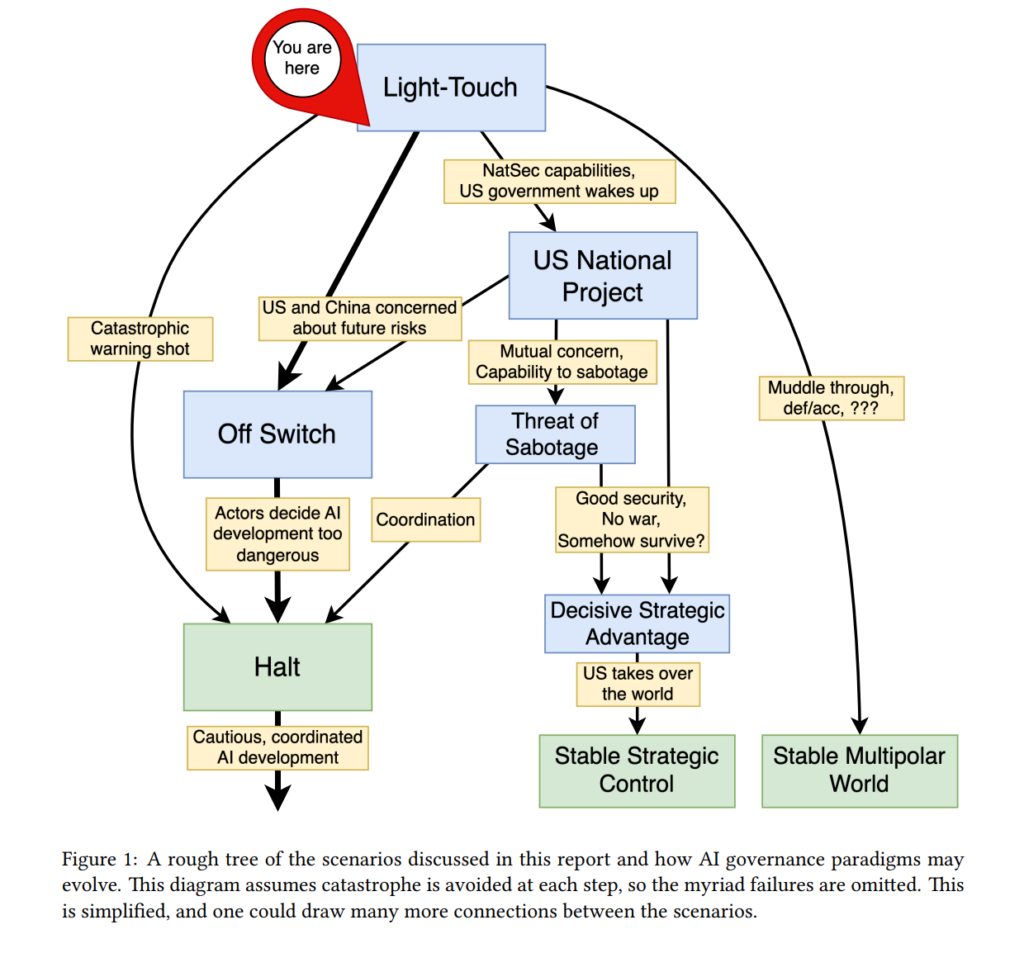
With AI capabilities rapidly increasing, humans appear close to developing AI systems that are better than human experts across all domains. This raises a series of questions about how the world will—and should—respond. In the research paper AI Governance to Avoid Extinction: The Strategic Landscape and Actionable Research Questions, originally published in May 2025, MIRI’s […] The post Summary: AI Governance to Avoid Extinction appeared first on Machine Intelligence Research Institute.

MIRI Blog
Steve Yegge

Steve Yegge

Steve Yegge: I was chatting with my buddy at Google, who's been a tech director there for about 20 years, about their AI adoption. Craziest convo I've had all year. The TL;DR is that Google engineering appears to have the same AI adoption footprint as John Deere, the tractor company. Most of the industry has the same internal adoption curve: 20% agentic power users, 20% outright refusers, 60% still using Cursor or equivalent chat tool. It turns out Google has this curve too. [...] There has…

Simon Willison's Weblog
Exploring the new `servo` crate

Exploring the new `servo` crate

Research: Exploring the new `servo` crate In Servo is now available on crates.io the Servo team announced the initial release of the servo crate, which packages their browser engine as an embeddable library. I set Claude Code for web the task of figuring out what it can do, building a CLI tool for taking screenshots using it and working out if it could be compiled to WebAssembly. The servo-shot Rust tool it built works pretty well: git clone https://github.com/simonw/research cd…

Simon Willison's Weblog
Comprehension Debt: The Hidden Cost of AI-Generated Code

Comprehension Debt: The Hidden Cost of AI-Generated Code

The following article originally appeared on Addy Osmani’s blog site and is being reposted here with the author’s permission. Comprehension debt is the hidden cost to human intelligence and memory resulting from excessive reliance on AI and automation. For engineers, it applies most to agentic engineering. There’s a cost that doesn’t show up in your […]

O'Reilly Radar — AI/ML
Esc